Objects/Maki no Takumi/The Atelier
蒔絵筆記具工房・匠
The Urushibara Atelier
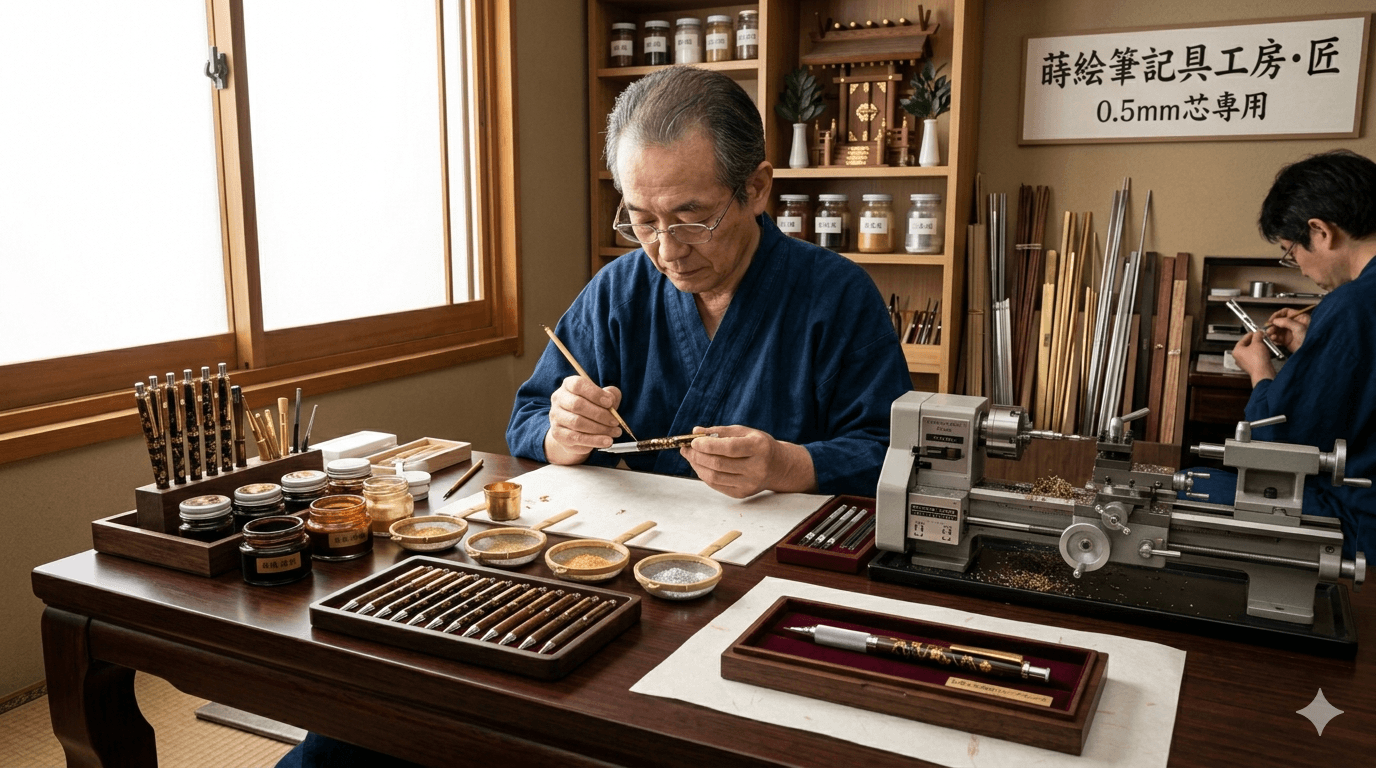
The workshop sits on a quiet street in Wajima, behind a sliding wooden door that gives no sign of what happens inside. A single hand-painted board above the bench states the whole of the atelier's ambition: 蒔絵筆記具工房・匠 — maki-e writing-instrument workshop — and beneath it, smaller, the line that tells you everything about the obsession at work here: 0.5mm芯専用. For 0.5-millimetre leads only. In two and a half centuries the Urushibara line has narrowed its entire art to a single calibre of pencil. They make nothing else.
There is only one machine in the building. A small precision lathe, mid-century, kept polished, used solely to turn the kuro-gaki blanks true before any lacquer is laid. Everything after that point is done by hand — and most of it is done at the window.
The North Window
The master works facing north. North light does not move the way south light does — it is cool, even, and unchanging from morning to dusk, and it is the only light under which the true colour of gold can be judged. Sunlight flatters; north light tells the truth. A blossom sprinkled under a warm afternoon sun will look wrong the moment it is carried into shade. So the bench has stood at the same north window for nine generations, and the gold is read there and nowhere else.
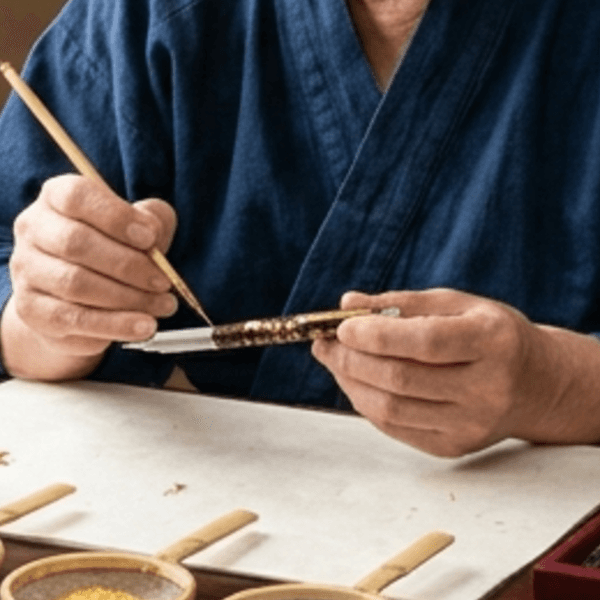
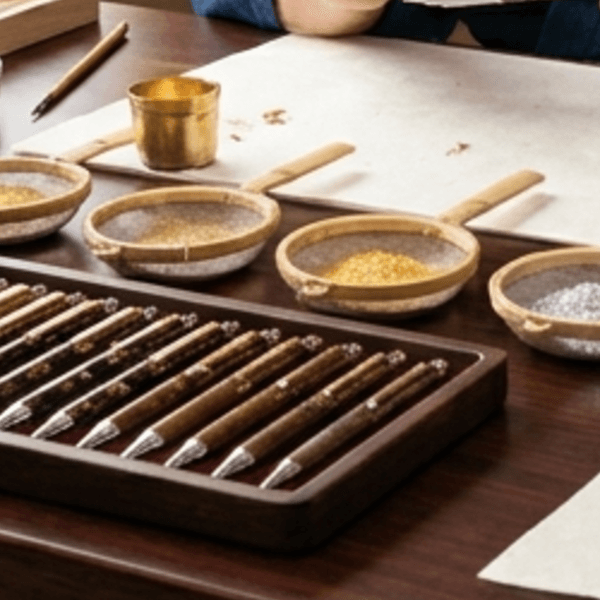
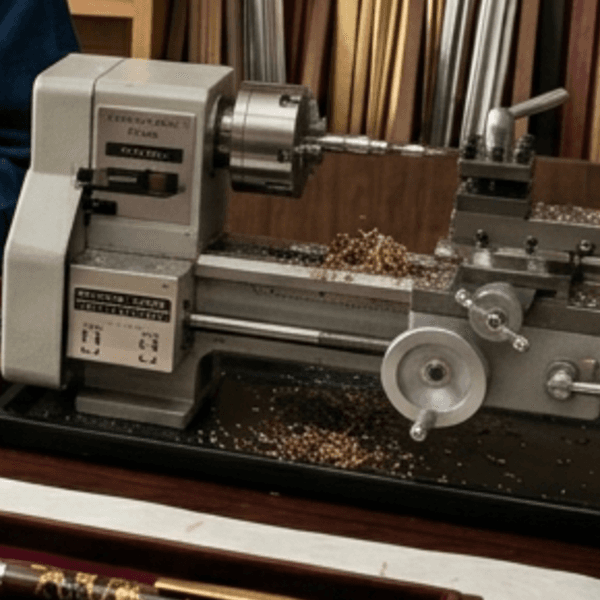
Left: laying the gold. Centre: the powder dishes. Right: the lathe.
Fifteen Kinds of Gold
Along the bench sit shallow bamboo sieves, each holding a different gold. They are not different colours — they are different grades, the same Kanazawa gold milled to fifteen degrees of fineness, from a dust finer than flour to a coarse glittering grain. A petal at the front of the composition takes one grade; the same petal, meant to recede into the current behind it, takes another. The illusion of depth in a maki-e picture is built entirely from the size of the gold, sprinkled through a bamboo tube and a fox-hair brush, particle by particle, onto lacquer that is still wet enough to hold it and dry enough not to drown it. The window in which this is possible lasts a few minutes. Miss it, and the surface is cut back and begun again.
“Nothing leaves this room
in the year it was begun.”
At the second bench sits the tenth generation. The successor has been in the room for eleven years and has not yet been permitted to sign a finished piece — the same apprenticeship the master served under his own father, and his father before that. The rule is not cruelty. Urushi is a material that punishes haste invisibly: a coat rushed today clouds in a decade, long after the buyer has carried it home. The nineteen years are simply how long it takes for the hand to learn patience the lacquer can trust.
The atelier keeps no showroom and admits no public. The only way through the wooden door is to commission a piece — and even then, the visit is by appointment, on a single afternoon, to discuss two things: the initial that will be engraved on the cap, and which season of blossom the gold should remember.